
Modeling Russian Authority: Orthodoxy and Legacy
Modeling Authority
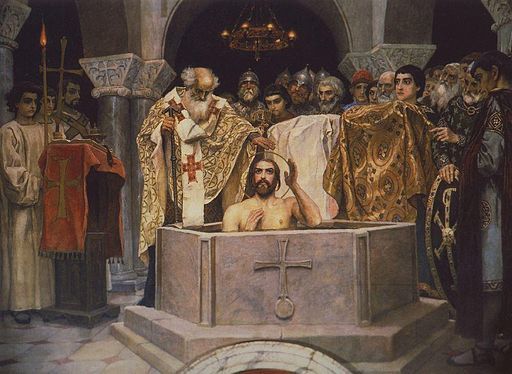
Russia was first christianized in the second half of the tenth century. Basil II, the Byzantine emperor, exchanged a marriage with his sister for much-needed military support from Vladimir, the ruler of Kievan Rus’. For this marriage to take place, the emperor required Vladimir to be baptized, and he was in the last half of the 980s (Sevcekno, 4). From the christianization of Kievan Rus’ onwards, the Byzantine Empire served as a strong cultural and religious influence for the people of the medieval Russian principalities. The Eastern Orthodox Church expanded its congregation, and Kiev was declared the seat of the new metropolitan. Kiev would remain the capital of Russian Orthodoxy until 1316 when the metropolitan moved his seat to Vladimir; six years later this seat would be moved to Moscow (Pelenski, 103). Moscow did not immediately incorporate this transfer of religious power into its political rhetoric (Pelenski, 102). Moscow, or Muscovy’s, real focus on the political use of religious power began in the mid-sixteenth century during the rule of Ivan IV, who came to power with the conquest of the Kazan Khanate in 1552 (Graney, 5). Ivan IV, better known as Ivan the Terrible, is particularly interesting, as he is the grandson of the first prince to be crowned tsar, a title with a lengthy and complicated history, and also the conqueror of a khanate that had once been part of the Golden Horde, to whom Russian princes had paid tribute for hundreds of years.
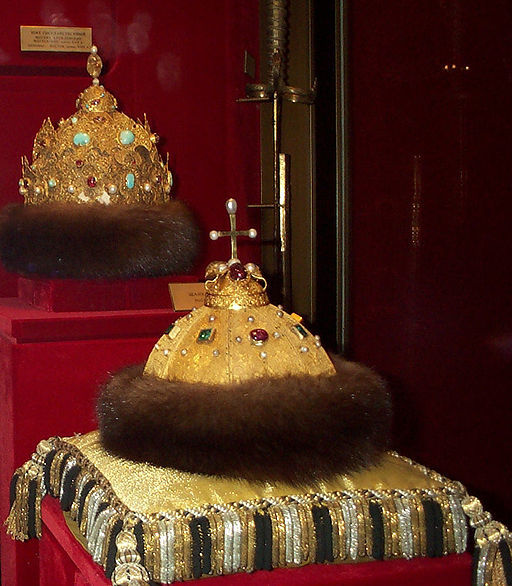
During the period of Mongol rule, beginning in the mid-thirteenth century, the Russian Church, still under Byzantine control, was given special exemption from taxes and military service, and also received special protections of their property (Crummey, 31). Such preferential treatment did not come without a price. Church documents, both in Byzantium and in Kiev, contain little criticism of the khan before the rule of Ivan III (Ostrowski, 164). In fact, prayers for the khan replaced prayers for the basileus, or Byzantine emperor, within the Russian Orthodox liturgy (Cherniavsky, 410). A rivalry for ideological supremacy existed between the models of khan and basileus, with the title of tsar embodying principles displayed by each model. At the center of this rivalry was the Russian Church, which benefited from both styles of rule, and sought a tsar who would continue to empower the Church. During the period between the overthrow of the Mongols and the crowning of the first tsar of Russia, it was the Russian Church that propagandized Moscow as the Third Rome, an idea that continues to this day (Crummey, 137; Poe, 413).
The Basileus and the Khan
The privileged status of the Russian church during the Mongol period situated the Church between the Byzantine Empire and the Golden Horde. As a subdivision of the Eastern Orthodox Church that was based in Constantinople, the Russian Church was answerable to the religious hierarchy and, at the same time, able to access the network of diplomacy provided by the “Byzantine commonwealth” (Crummey, 34). However, within the context of Muscovy and other medieval Russian principalities, the Russian Church was one of the most important intermediary organizations for the Golden Horde. The Eastern Orthodox Church encouraged its Russian subdivision to uphold the diplomatic alliance that existed between Byzantium and the Golden Horde, but, at the same time, the Russian Church had its own incentives to coexist peacefully with the khans. As much as it depended upon Byzantium for religious administration, the Russian Church depended on the Qipchaq Khanate for secular administration. This conflict of loyalty resulted in the conception of the ideal Russian ruler as a combination of the qualities displayed by the basileus and by the khan.
The basileus, the “image of rulership” after the baptism of Vladimir, was awarded a special place in the Russian liturgy (Cherniavsky, 405). Soon, the various princes of the former Kievan Rus’ territories imitated the basileus by inserting their own names into the portion of the Orthodox liturgy that had formerly been reserved for the basileus (Cherniavsky 405-406). After the conquest of the Mongols, however, these prayers (and also the title of tsar) went to the khan, and an uneasy, non-Christian model of power emerged. The basileus’ merging of secular and religious authority was projected onto the khan, and he was seen as God’s chosen ruler; his rule was at once sanctioned by God and God’s punishment for the sins of the people (Ostrowski, 146).
The title of tsar was used interchangeably for the basileus and for the khan (Ostrowski, 180). The Muscovite tsar, then, had to embody the Mongol model of sovereign conquerer and the Byzantine model of religious autocrat. The Russian Church, at the center of the two rulers, sought to maximize its own position by combining the two forms of rule into a tsar that was influenced by Church leaders and protected the Church’s possessions. Especially after the fall of Constantinople in 1453 when the Russian Church became the Russian Orthodox Church, the Church sought to exert itself in the political fabric of Muscovy. Ivan III, after his marriage to the niece of the basileus and the collapse of the Byzantine Empire, began to style himself as tsar; his son, Vasili III, also styled himself as tsar, and in 1547, Vasili’s son, Ivan IV was the first crowned tsar of Russia (Ostrowski, 178). The Russian Orthodox Church played a special role in the reign of these three Muscovite tsars, successfully promoting Orthodoxy while also experiencing the loss of property and status. Though the Church did have a prominent role in the politics of the new Russian tsardom, the autonomy of the Mongol years was limited. Negotiating the models of khan and basileus, the Russian Orthodox Church was fundamental in the formation of the Russian tsar, and remains a power today, influencing both citizens and rulers.
The Legacy of Kievan Rus'
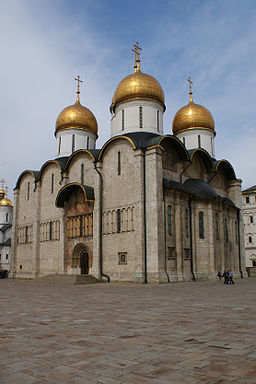
Russia has long sought to be the inheritor of the legacy of Kievan Rus’. It was the Russian Church that first laid hold on this legacy, beginning with the attempt to move what was the Metropolitanate of Kiev to Muscovy. The Church’s fight for Kievan Rus’ soon involved the Muscovite court, and the quest for legacy led Muscovy to associate itself with Byzantium after the fall of Constantinople (Pelenski, 105; Ostrowski, 142). As the inheritor of the legacy of Kievan Rus’, Muscovy would able to assert its claim on Kievan Rus’ former territories, and its status as the true regional power. Accordingly, the Church and the Muscovite court distanced themselves from the Qipchaq Khanate. The idea of the “Mongol Yoke” was introduced, and the conception of the tsar veered towards the model of the basileus. During the period leading up to the creation of Patriarchate of Moscow in 1589, three metropolitans of Kiev and all of Rus’ were canonized (Pelenski, 107). All three of these men had political roles within the Muscovite court, mirroring the Byzantine patriarch’s advisement and support of the basileus. By taking on the religious and political authority of Kievan Rus’, Muscovy established itself as the true Russian power in the years leading up to the creation of the office of the Russian tsar.

The Third Rome
The idea of Moscow as the “Third Rome” was first proposed in the sixteenth century by a Muscovite monk. Originally, the “Third Rome” was an entirely ecclesiastical concept. Over time, this idea “came to be seen as the Rosetta Stone of the Russian historical process” (Poe, 413). As the most powerful Orthodox state after the fall of Constantinople, Russia inherited the Byzantine legacy of both Christian and political authority, culminating in the establishment of the Moscow Patriarchate and the crowning of Ivan IV as tsar of Russia, instead of simply Muscovy. However, the conception of Roman, imperial legacy was only taken up by political actors after Peter the Great styled himself as emperor, rather than as tsar. The “Third Rome” idea was “revived” during the reign of Alexander II, when “late Imperial historians… were convinced that ‘Third Rome’ was a reflection of Muscovite imperial ideology” (Poe, 413). The popularity of Moscow as the “Third Rome” experienced great fluctuation, becoming popular in the early Soviet period, before being condemned in the last half of the twentieth century, and finally receiving a new life in the post-Soviet era.
Once the conquered territory of the Qipchaq Khanate, Moscow evolved into an imperial power that conquered lands to whom it once paid tribute. As the “Third Rome”, Moscow chose its European heritage over its Asian heritage, embracing the new imperial identity of European superpower. However, during Russia’s imperial period, administrations such as that of Catherine the Great showed a great amount of tolerance for non-Russian, non-Christian peoples. The Russian Empire, like the Mongols, often employed the strategy of using local political elites and local religious elites to manage subject populations. This tolerance and cooperation marked a great difference from other empire in the Russia’s relationship with non-Russian populations.
Though many societies have laid claim to title of “Third Rome”, Moscow’s claim is unique and evolving. Russia embodies imperialistic and collaborative principles of Rome, but is unable to be classified as a strictly European power. The idea of the “Third Rome” is yet another attempt for Russia to classify itself as a Western power. As the idea has waned in popularity and state influence, so has Russia’s association with the West. There is something strange in classifying Moscow as the “Third Rome”, instead of St. Petersburg, the seat of Russian imperialism. Moscow and St. Petersburg, one a former medieval principality and Mongol possession and the other an imperial construction, show two distinct sides of Russia that are difficult to reconcile. The “Third Rome” idea fits into the pattern of conflicting cultural association that continues to intrigue the outside world. In different periods, Russia has sought identification with different parts of the globe. This state of liminal cultural affinity serves to singularize Russia, even as ties to both East and West make Russia a global power.
Works Cited:
Cherniavsky, Michael. “Khan or Basileus: An Aspect of Russian Medieval Political Theory.” The Expansion of Orthodox Europe. Ed. Jonathan Shepard. Burlington: Ashgate, 2007. 403–420. Print. The Expansion of Latin Europe 1.
Crummey, Robert O. The Formation of Muscovy 1304-1613. Print. New York: Longman, 1987. Print.
Graney, Kate. “Making Russia Multicultural: Kazan at Its Millennium and Beyond.” Problems of Post-Communism 54.6 (2007): 17–27. Print.
Ostrowski, Donald. Muscovy and the Mongols. New York: Cambridge University Press, 1998. Print.
Pelenski, Jaroslaw. “The Origins of Muscovite Claims to Kievan Inheritance.” Slavic Cultures in the Middle Ages. Ed. B. Gasparov. University of California Press, 1993. 102–115. Print.
Poe, Marshall. “Moscow, the Third Rome: The Origins and Transformations of a ‘Pivotal Moment.’” Jahrbücher für Geschichte Osteuropas 49.3 (2001): 412–429. Print. Neue Folge.
Sevcenko, Ihor. “The Christianization of Kievan Rus’.” The Polish Review 5.4 (1960): 29–35. Print.