
Russia from a Global (investor's) Perspective
An investment is an expression of opinion in a very concrete way: you are literally putting your money where your mouth is. This project seeks to understand the modern history of Russia (from the breakup of the Soviet Union to the present) by exploring these foreign expressions of opinion, in other words, foreign investment in Russia.
Due to a litany of regulatory, tax, and custom difficulties, foreign investors mostly limited their investments in Russia to paper assets, namely portfolio investment and debt investments. [1] This exhibit focuses on the latter, exploring foreign demand for Russian bond, which through most of the post-Soviet era included only sovereign debt, but which has more recently expanded into corporate and municipal bonds as well. The project focuses on ruble-denominated bonds, though at times, because of the economic climate, ruble-denominated bonds were unfeasible and U.S. dollar-denominated bonds were issued instead. The analysis does not differentiate between foreign investment in Russian bonds and domestic investment, but because of the international capital market’s dynamics, changes in the Russian market largely reflect opinions of foreigners because of the outsized role they have played in the market for the past 20 years. The sentiments of foreign investors, expressed in their purchases of various bonds over time, is a barometer of their opinions of Russia’s economic and political prospects. Put in simple terms, when foreign investors are willing to invest freely at low rates, they are expressing confidence in Russia’s future; when foreign investors retrench from the Russian bond market, causing yields to spike, or worse yet, when they refuse to buy at all, they are expressing pessimism about Russia’s prospects and ability to sustain a stable economic environment.
Setting the Stage: The End of The USSR
For a long time, the Soviet Union had an impeccable international credit rating, and foreigners were willing to lend at low rates, certain that they would be paid back from Soviet oil exports.[2] The Soviet Union often borrowed to finance food imports or higher domestic consumer spending.[3] Yet, in the late 1980’s, the Gorbachev government drastically increased its level of borrowing as oil prices declined and food needs increased. It soon became clear that the USSR would not have the funds to make its bond payments, and in November, 1991 the Vneshekonombank, the foreign trade bank of the USSR, defaulted on its debts (~US$11 billion).[4]
1991-1993: Russia in Chaos
On Christmas Day 1991, the breakup of the Soviet Union was finalized, ending over 70 years of a centrally planned economy. As part of the breakup, the newly formed Russian Federation assumed all of the USSR’s debt in exchange for certain assets from the former Soviet satellites. Unfortunately, the debts were large (~$120 billion) while the assets were small (~15 Billion).[5] The combination of the immense debt burden, the recent Vnechokonombank default, and the uncertain economic climate scared off foreign private lenders, who were unwilling to extend credit to Russia, which desperately needed money to feed its population through the winter and fund its economic transition. Instead, Russia had to rely on loans extended by western governments for geopolitical reasons through the IMF.[6] This reliance on “public” credit continued for a few years. This period, during which there was hyperinflation, a massive depression, political instability, and social turmoil, marked the nadir of foreign investors' faith in Russia’s economic future.
1994-1998: A Speculator’s Paradise
Due to the “great moderation” of Western economies from 1980-2000, which reduced both inflation and interest rates, Western investors sought opportunities that promised a higher return. Russian sovereign ruble bonds were one such investment (particularly a short term bond called a GKO).[7] When, in 1996, the Central Bank of Russia (CBR) liberalized the capital markets, facilitating foreign investment, Western investment increased significantly. These foreign investors hoped to take advantage of the carry trade—converting dollars into rubles and purchasing Russian government bonds, which paid high rates of interest, and then eventually converting ruble returns back into dollars at the future exchange rate. The key to the carry trade was for the exchange rate not to depreciate so much as to wipe out the excess returns from higher interest rates. In the 1995-1998 period, the ruble-to-dollar exchange rate was particularly stable, largely due to the Russian Federation’s policy of maintaining a stable exchange rate as a symbol of its control over the economic situation.
To foreign investors, the stable exchange rate was a sign of financial responsibility and economic prosperity. Despite the persistent government fiscal deficits (which necessitated the bond sales), there was a sense that Russia was successfully transitioning towards a market economy. The hyperinflation of the early 90’s had been tamed, and investors saw the bonds as stopgap funding until the government got its fiscal situation righted. Additionally, the re-election of Boris Yeltsin in 1996 gave investors faith in Russian political stability for four more years.[8] On the whole, as Martin Gilman, the former IMF Russian Section Chief who steered Russia through the tumultuous 90’s, notes: “By the summer of 1997, non-resident investors appeared ready to buy just about any asset with Russia stamped on it.”[9]
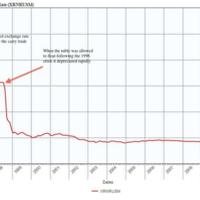
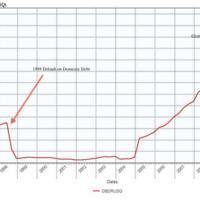
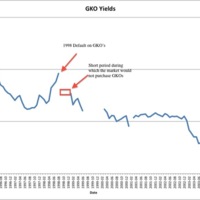
For additional information view charts of the ruble exchange rate (1), ruble-denominated debt (2), and GKO yields (3).
1998: CRISIS!
Suddenly, in the fall of 1997, foreign investors started to pull out of ruble-denominated government bonds, raising yields and depleting the CBR’s dollar reserves.[10] These initial market jitters were initially thought to be a reverberation from the economic crisis in other emerging market economies, particularly in Asia.[11] Unfortunately, at the same time, the Russian government’s fiscal situation deteriorated. The Russian Federation budget had been in a persistent deficit since its inception, in large part due to the inability to collect sufficient tax revenues.[12] From 1997-1998 these fiscal problems were exacerbated by weaker than expected growth and lower oil prices.[13] Furthermore, the higher yields on government bonds increased the cost of borrowing and further hurt the government’s fiscal situation.
The deteriorating fiscal situation discouraged many foreign investors. The Russian government was unable to regularly auction new GKOs, and investors refused to roll over maturing securities. Right before the crisis, the three-month GKO yield jumped to over 200%, reflecting the market’s uncertainty about the Russian government’s ability to meet its payments. On August 17, 1998 the Russian government was unable to make its short-term bond obligations, effectively defaulting. As a result, the ruble was allowed to float, and immediately depreciated; there was a three month moratorium on repayment of foreign debt; and, GKO refinancing was required. [14]
At the time the Russian government had 340 billion rubles of local-currency debt (US$55 billion) and about US$150 billion of foreign-currency debt, 2/3 of which was a holdover from the Soviet era.[15] At the time of default, the Russian GDP was about US$ 400 billion, making total debt equal to about 50% of GDP. As a result of the default, the ruble, which was allow ruble to float, which rapidly depreciated.
For additional information view charts of the nominal exchange rate (1), ruble-denominated debt (2), GKO yields (3), and 10-year bond yields (4).
1999-2002: Rebuilding Confidence
The default on Russia’s ruble-denominated debt temporarily scared off foreign investors.[16] Beyond doubting the Russian government’s ability to repay future debts, a large sovereign debt and currency crisis usually causes extreme political and economic turmoil, exactly what foreign investors try to avoid. [17] Yet, for Russia this instability never truly materialized. While there was some government instability and economic contraction, both were relatively mild and brief. In a strange twist of fate, the extreme ruble devaluation ended up helping the Russian economy recover from the crisis through more competitive exports. Additionally, the combination of new tax policies and rebounding oil prices improved the government's fiscal position
Foreign investors returned sooner than one would have expected. When the Russia government issued foreign currency bonds in 2000, they paid a reasonable interest rate of 7.5%.[18] This appetite from foreign investors reflected the optimistic outlook on Russia’s economic future (which would be confirmed with 10% GDP growth in 2000) and on the political stability brought about by the recent election of Vladimir Putin. In 2000, the government resumed issuing GKO’s, the very same instruments on which they defaulted in 1998.
For additional information view charts of GKO yields (3) and 10-year bond yields (4).
2002-2008: A Hot Commodity Once Again
Fueled by the growth of its oil and gas exporting sector, the Russian economy boomed in the mid-2000’s, creating huge surpluses. These surpluses allowed Russia to pay off its Soviet-era debt and even some of the 1998 defaulted debts. Having learned from the 1998 crisis, Russia accumulated massive dollar reserves and a stabilization fund in case oil revenues declined. Instead of issuing government bonds to fund deficits, the Russian government borrowed to build a yield curve and create a history of payment. (In layman’s terms, Russia kept the borrowing channels active in case they were needed in the future).
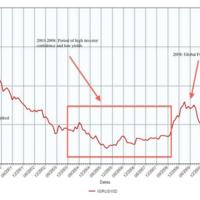
Investors jumped to buy new types of Russian bonds based on Russia’s new economic strength. Whereas before, foreign investors primarily purchased sovereign debt, now they purchased ruble-denominated corporate and municipal bonds. The issuance of corporate and municipal debt represents a deepening of the Russian financial system and increasing faith in the Russian economy. (Both corporate and municipal bonds are typically substantially riskier than government issued ones). In addition to these new types of bonds, the yields on ruble-denominated sovereign bonds of 5, 10 or even 15 years reached record lows. Investment in these long-term bonds reflected a belief not just in Russia’s ability to repay or refinance the debts in a couple of months, but its ability to fulfill its obligation years into the future. Not surprisingly this period of investor confidence coincided with a period of extreme political stability under President Vladimir Putin. During this time, the World Bank went so far as to declare that the Russian economy had achieved “unprecedented macroeconomic stability.”[19]
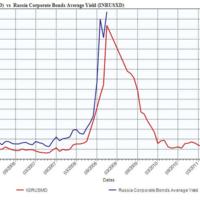
For more information view charts 10-year bond yields (4) and municipal and corporate bond yields (5).
2008 Global Financial Crisis
Almost 10 years to the month of Russia’s sovereign debt and currency crisis of 1998, Russia once again found itself in crisis. This time the crisis was not specific to Russia but global, yet again foreign investors retreated. Bond yields of all sorts spiked, as investors demanded a greater premium to invest in Russia. Additionally, the ruble depreciated by almost 1/3 as foreign investors repatriated their assets. For all the economic progress Russia had made, in the eyes of foreign investor, Russia remained an emerging market to be avoided in times of uncertainty.
Russian economic fundamentals and political stability also deteriorated during the crisis. In 2009, the economy contracted at 7.8%. This contraction, in combination with declining oil prices, sent the government into a deficit for the first time since the early 2000s. In 2010, the Russian government issued dollar-denominated bonds for the first time in ten years, reflecting the market’s hesitancy to purchase Russian ruble-denominated debt. Finally, 2008 marked the election of new Russian President Dmitry Medvedev, ending eight years of Putin’s presidency and bringing a new face and some policy uncertainty to the Russian White House.
For more information view charts of the ruble exchange rate (1), 10-year bond yields (4), and municipal and corporate bond yields (5).
2010-2014: Recovery Again
By late 2010, however, Russia’s economy was in recovery and, once more, investors returned to Russian bonds. Yields on government and non-government ruble-denominated bonds declined from their crisis peaks, which reflected renewed faith in Russia’s economic recover. In 2012, the Russian government successfully issued its longest duration, local currency bonds of 15 and 25 years, reflecting investors’ belief in Russia’s long-term prospects. Finally, in 2012, the familiar face of Vladimir Putin returned to the presidential palace in a smooth transition, reinforcing investor’s beliefs in long-term stability.
For more information view charts of 10-year bond yields (4) and municipal and corporate bond yields (5).
2014: Crimea and Punishment—Geopolitical Crisis
Recently, however, foreign investors’ faith in Russia was drastically shaken by a geopolitical, not financial, crisis. In March 2014, the political unrest in Ukraine spilled over into the Russian financial markets when Russia decided to annex Crimea (a part of Ukraine), sending troops to the strategically important peninsula. Many members of the international community viewed the annexation of Crimea as a violation of Ukrainian sovereignty and blamed Russian President Vladimir Putin for the social unrest. In response, the United States and many Western European nations issued sanctions against Russia. As a result, Russian bond yields spiked, reflecting investors lack of confidence in Russia’s economic and geopolitical future, particularly in light of potential further sanctions. Investors’ trepidation has been reinforced by the decision of the bond rating agencies to cut Russia’s rating to BBB-, one step above a junk bond level.[20] At the moment, it remains to be seen how the situation will play out or what foreign investors will think, yet, once again Russia is clearly “on the outs” with foreign investors.
Conclusion:
Over the past 20 years, foreign debt investors have expressed a wide range of sentiments concerning Russia’s future, from frenzied optimism in the mid-90’s, early 2000’s, and post-financial crisis period, to strong pessimism in the first years of the Russian Federation, the 1998 crisis, and the global financial crisis in 2008. These vacillating sentiments have caused Russian bond yields to spike and plummet. These sentiments have also caused certain bonds to be momentarily embraced, then shunned, then embraced again. Despite recent trepidation by foreign investors because of the events in Crimea, it is clear that investors have a much more optimistic outlook on Russia’s future now than they did in the early days of 1992. While Russia may still be an emerging market, subject to the ups and downs that that entails, there can hardly be any doubt, as there was in the pas, that Russia will eventually emerge. When it does, the foreign investors will be right there, putting their money where their mouths are.
[1] Martin Gilman, No Precedent, No Plan: Inside Russia’s 1998 Default (Cambridge, MA: MIT Press 2010) 34.
[2] “C. R. Neu, “Soviet International Finance in the Gorbachev Era,” RAND: National Defense Research Institute, 1991. http://www.rand.org/content/dam/rand/pubs/reports/2009/R4116.pdf.
[3] Yegor Gaidar, “The Soviet Collapse: Grain and Oil,” American Enterprise Institute for Public Policy Research, April, 2007.
[4] Martin Gilman, No Precedent, No Plan: Inside Russia’s 1998 Default (Cambridge, MA: MIT Press 2010) 21.
[5] Ibid. 33.
[6] Ibid.
[7] A GKO was a short-term, zero-coupon bond issued by the Russian government.
[8] In fact, at the time of the election, when Yeltsin’s victory was still up in the air, GKO yields spiked, reflecting Russia’s potential political instability.
[9] Ibid., 31.
[10] After the foreign investors sold their bonds, they wanted to convert their rubles into dollars, which they viewed as more stable. With the relatively low demand for rubles and high demand for dollars, the RCB had to be willing to purchase the rubles (with dollars) to maintain the stable exchange rate that they were intent on keeping. Propping up the exchange rate like this ended up draining a large portion of RCB’s dollar reserves.
[11] Martin Gilman, No Precedent, No Plan: Inside Russia’s 1998 Default (Cambridge, MA: MIT Press 2010) 112.
[12] The government was issuing bonds to close this budget deficit.
[13] Russian GDP growth came in at 1.7% for 1997, while this was the first year of positive growth since the breakdown of the USSR, but it was far bellow the 3.0% estimate the government had made in its actuarial assumptions.[13] The Russian Federation tax on oil exports made up a large portion of its budget, and the almost 40% decline in worldwide oil prices due to the Asian Crisis significantly lowered government revenue. For more information see Martin Gilman, No Precedent, No Plan: Inside Russia’s 1998 Default (Cambridge, MA: MIT Press 2010) 135
[14] Martin Gilman, No Precedent, No Plan: Inside Russia’s 1998 Default (Cambridge, MA: MIT Press 2010) 191
[15] Ibid., 186.
[16] It is important to note that Russia defaulted only on a portion of its ruble-denominated debt; it continued to service its foreign currency debt.
[17] Robert Feenstra and Alan Taylor, International Macroeconomics (USA: Worth Publishers 2012) 312.
[18] Stephan Wagstyl, “Russia Launches $7bn Bond Issue,” Financial Times, March 28, 2012. Accessed April 28, 2014. http://blogs.ft.com/beyond-brics/2012/03/28/russia-launches-7bn-bond-issue/.
[19] Konstantin Rozhnov, “Russia Attracts Investors Despite its image,” BBC News, November 30, 2007. Accessed April 29, 2014. http://news.bbc.co.uk/2/hi/business/7096426.stm.
[20] Elaine Moore, “Russia Puts Stop to Debt Sales as Ukraine Crisis Escalates,” Financial Times, April, 28 2014. Accessed May, 1 2014. http://www.ft.com/intl/cms/s/0/1fe65c76-cc7f-11e3-bd33-00144feabdc0.html#axzz30TSqLVT5.