
For Love of Country
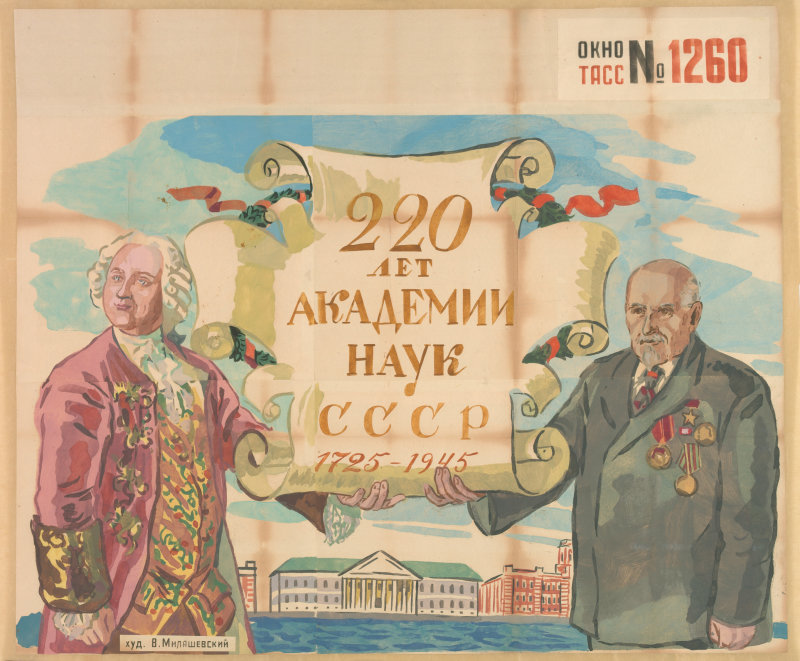
Having seen that the state wants to associate with science, we now look at science associating itself with the state. The first situation is immediately following the 1917 revolution. Intellectuals at the time had good reason to be fearful of the new regime: “In 1919, [Lenin] began mass arrests of professors and scientists who had been Kadets [Constitutional Democrats], and deported Kadets, Socialist Revolutionaries, Mensheviks, and Nationalists. The Bolshevik leadership sought rapidly to purge Russia of past leaders in order to build the future on a clean slate.” (“Attacks on Intelligentsia” 2014) It then comes as a surprise that the Academy was able to form a tentative alliance with the Lenin-led government: “In 1917 Ol’denburg [secretary of the Academy] and Vladimir Il’ich Lenin had formed an alliance, bringing together scholars and Bolsheviks; the Academy had provided the regime with expert knowledge and had been granted in exchange funding, protection, and a considerable degree of scientific freedom.” (Hirsch 2014, 140) Admittedly, the members of the Academy, which would eventually be renamed the Academy of Sciences of the USSR in 1928, may have taken this course of action simply for the sake of saving their own skins. But there were probably safer courses of action than continuing to do true science, instead of meeting demands that the Academy become a “Marxist-Leninist institution” (Hirsch 2014, 140). Instead of taking a safer course, the members of the Academy continued their work, because they didn’t want to forsake Russia’s scientific progress. They wanted to continue to support science in Russia, since science is the same regardless of the leader of the day.
We see a similar situation playing out in the past year. In response to funding tensions in the membership of the Academy, “a bill was hastily introduced to the Russian parliament that, if approved, would effectively liquidate the academy in its present form.” (“Russian Roulette” 2013) The current academy would be drawn in under the Russian government, and lose much of its freedom on its choice of actions and material management. The effort instigated by President Putin met with significant opposition both internationally and domestically. Numerous members of the current Academy announced their intention of not joining the new “academy” if the plan was carried out. (“Открытое Письмо Членов РАН По Поводу Ликвидации Российской Академии Наук. Letter of Members of Russian Academy of Sciences” 2013) Like in the past, the current members of the Academy want science to be associated with Russia—to be a powerhouse of research like in years prior. They are willing to sacrifice much to reach this goal.