
1. Media Perspectives - the Quarrel in Narrative
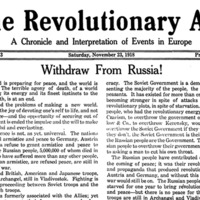
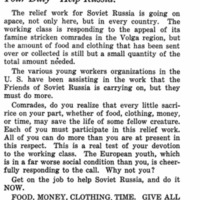
The saturation of anti-Soviet rhetoric in American media produced in American communists a state of parallax, perceiving the Soviet union from two competing lines of sight. The most immediate and readily accessible news came through traditional channels. So even as communists produced their own publications, they remained consumers of the mainstream narrative. Young Worker magazine warned its budding communist readers against trusting the “bourgeois press” in a 1922 article explaining how the owners of capitalist publications imposed their biases on purportedly objective reportage.[ii] Likewise, in The Revolutionary Age (predecessor to The Communist), John Reed published accounts of his own experiences in Soviet Russia, denying the news media’s claims that, in Reed’s words, “the Russian workingman gets enormous wages, refuses to work, and that in short he has ruined Russian industry.”[iii]
The rift in these branches of media is to large extent on the level of interpretation rather than facts. Consider, for example, the significance of an article published by Lenin in April 1918, “The Soviets at Work,” in which he discusses the shift from overthrow to governance and the management system necessary to make the Revolution succeed. Reed pushes back against critics who interpret Lenin’s proposal as a reversal of the Bolshevik power redistribution — essentially as an admission of failure. In telling the revolutionary masses that they must submit to management and governance, was Lenin proposing a top-down system that ran contrary to the bottom-up ideology of the revolution? Reed insists he was not. Building the governance structure of the new state, in Reed’s interpretation, was a project of constructing the communist state, not the abandonment of a failed dream. In fact, the success or failure of the Soviet State remained a crucial point of contention over the decades — in part out of a dearth of reliable information, but largely due to the inherently biased interpretive stances.
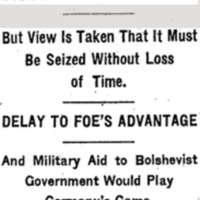
However the distinction between the reporting of facts and their interpretation is not clear-cut. In 1920, Walter Lippmann and Charles Merz conducted a systematic study of the coverage of the Bolshevik Revolution by the New York Times. Looking only at the reporting of historically certain events in news articles, not editorial pieces providing evaluative comments, Lippmann and Merz systematically uncovered its biases. Look, for example to item A., a front page headline in May, 1918 enumerating the risks of delaying intervention in Russia. This support of American intervention in Russia was a particularly blunt bias. It was not however rooted in pure ideology, but in a rigid conception of what it meant to be Russian. An article published in August 1918 writes of the “true voice of Russia, the voice of non-Bolshevist Russia,” which “besought the help of the Allies, and the Allies could not continue deaf to that insistent appeal.”[iv] As in any civil war, these distinctions between the Russia and its foe became murky. But in its rhetoric, the New York Times painted a rigidly specific picture of the true Russia that jarred sharply with the story told in the leftist media.
In this project, Lippmann and Merz were not acting as fringe elements. A founding editor of The New Republic magazine and advisor to President Woodrow Wilson, who would later coin the term “stereotype” and popularize the phrase “Cold War,” Lippmann as not looking to expose falsehoods in the capitalist media. His project was rather to the intrinsic biases of reporting of all kinds, looking at a high-caliber newspaper to show that these biases were pervasive in mass media of all strata. Merz and Lippmann concluded, “In the large, the news about Russia is a case of seeing not what was, but what men wished to see… The chief censor and the chief propagandist were hope and fear in the minds of reporters and editors. They wanted to win the war; they wanted to ward off bolshevism.”[v] The story told by the mainstream media was tremendously misleading, but not the product of a deliberate propagandistic syndicate, as many communist publications claimed.
[i] "The Bourgeois Press." Young Worker (1922): 15. Marxists Internet Archive. Web. 03 May 2014.
[ii] odib.
[iii] Reed, John. "The Origins of Worker's Control of Industry in Russia." Revolutionary Age 23 Nov. 1918: 4. Marxist Internet Archive. Web. 04 May 2014.
[iv] Lippmann, Walter, and Charles Merz. "A Test of the News." New Republic 4 Aug. 1920: n. pag. Internet Archive. Web. 4 May 2014. p15
[v] idib. 3.