
2. Through the Lens of the American Left
"My little friend in Petrograd will never be taught to “draw” like James Montgomery Flagg or like Gibson or like Stanlaws or to aspire to do so. He will never learn to admire the kissing pictures on the covers of our 15c magazines. In order to be noticed at all he will have to develop himself. He will have to create something. There will be for him no terrible effacing pattern to go by. So he has ten chances to one against his American cousin."- Louise Bryant, "Art for American Children [i]
------
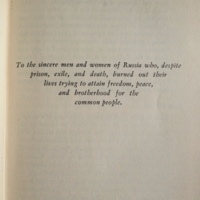
The Vanguard Studies of Soviet Russia aim to cut through the hazy pictures presented by American media by turning to facts and first-hand experiences. But each volume is accompanied by a curious epigraph:
“To the sincere men and women of Russia who, despite prison, exile, and death, burned out their lives trying to attain freedom, peace, and brotherhood for thecommon people.” [ii]This epigraph, presumably composed by Davis, is particularly curious for its poetic sincerity in contrast to the relatively dry texts on such subjects as Soviet economic organization. In its carefully structured line breaks it brackets the periods of turmoil and the struggle for freedom, narrowing towards the ultimate symbol – the common people. It functions to bind the series’ quest for facts with a cultural picture of what it means to be Russian in the Soviet era. Several words jump out as characteristic of the leftist media’s cultural portrayal of the Soviet Union. Brotherhood is of course a founding idea, but this equality is characterized by the “sincere” populous. The idea of sincerity and passion defined the leftist publishing industry in the decade following the revolution, portraying the Soviet relationship to the arts as passionate, in contrast to colder vision of capitalist art in America.
In Louise Bryant’s narratives of the Russian Revolution, a cultural picture of Russia emerges out of an ideological one. In a 1919 article, “Art for American Children,” Bryant made the claim that, “[i]n Russia art is not a luxury like it is in our United States; it is never wholly an amusement, it is a vital part of life, a necessity.”[iii] Her argument was that Russia, Soviet Russia in particular, was a place where children were not taught to draw through imitation of great artists, that they are neither taught at all. In this environment artistic growth was a product of self development, of channeling feeling rather than imitating it. Independent of its veracity, this Bryant’s picture of the development of Russian artists is one of self development, in which every achievement is earned through hard work. In it we see that communist rhetoric directed towards industry also shaped the American left’s cultural picture of Russia.
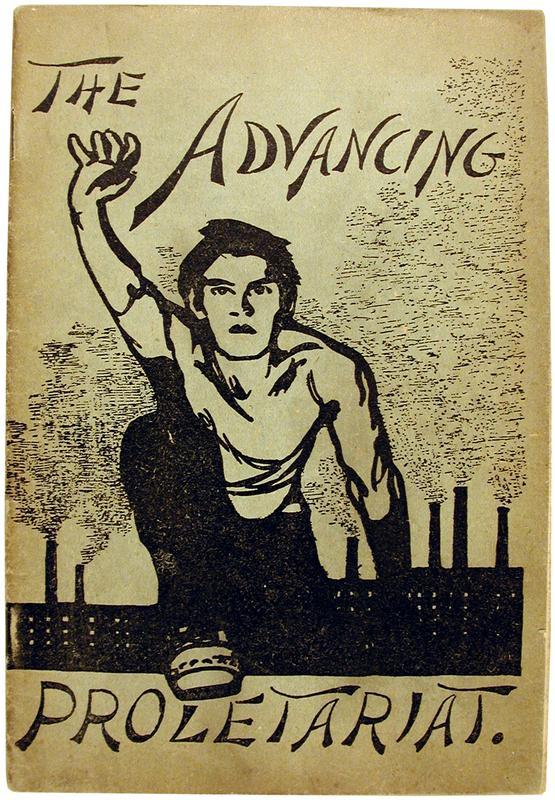
In the leftist publishing industry, we see that the ideology of American communism was not simply political, but aesthetic in its ambition for a complete cultural transformation. Lousie Bryant and John Reed, her husband, provide a particularly interesting lens through which to understand the leftist publishing industry because they were so deeply rooted in the world of the arts. They envisaged a Russian culture not refined and polished for display, but driven by passion, a populist vision of self generated artistic talent. A particularly powerful illustration of this ideal is Max Eastman’s magazine The Masses, in which a socialist ideology was not displayed in the form of manifesto but of artwork, cartoons, poetry and literary prose.
In the rhetoric of this community of intellectuals and artists, we can see how an aesthetic vision shaped the American left’s perception of the newly formed Soviet Union. Consider a poem entitled “To Nikolai Lenin,” written by Eastman and published in The Liberator, successor to The Masses. Eastman writes of the two phases of revolution. Firstly, there is the aspirational phase, defined by the ideology and philosophy of “[m]en that have stood like mountains in the flood / of change… their mind / Unmaddened with the madness of their kind”. In this poem Lenin possesses this mountainous quality of steadiness and faith, but he does not simply stand above the flood. He descends into the floodwaters, shaping the nature of those tides of change: “And with its motion, moving it, you blend / Your conquering purpose…”[iv] In the form of poetry, Eastman echoes Reeds analysis of Lenin’s recently published “The Soviets at Work” (see page 1 - Media Perspectives). But in turning to verse, he translates the language of policy and pragmatism to a more eternal, lasting language of poetic beauty.
In times when facts were few and interpretations numerous, when the media presents a narrative in constant flux, the arts perform a stabilizing function. Presenting a cultural vision of what Russia could be and evoking the aesthetic sympathies in conduction with ideological ones, American communist publications in immediate post-revolutionary period shaped twentieth century leftist rhetoric.
[i] Bryant, Louise. "Art for American Children." Playboy Jan. 1919: 11. Marxist Internet Archive. Web. 04 May 2014.
[ii] Nearing, Scott, and Jack Hardy. The Economic Organization of the Soviet Union. New York: Vanguard, 1927. Print. Vanguard Studies of Soviet Russia.
[iii] Bryant, Louise. "Art for American Children." Playboy Jan. 1919: 11. Marxist Internet Archive. Web. 04 May 2014.
[iv] Eastman, Max. "To Nikolai Lenin." Liberator Nov. 1918: 17. Marxist Internet Archive. Web. 04 May 2014.